 ProductReveal
FetchSandbox
The Smart Sandbox for Modern API Development.
About this product
FetchSandbox is an innovative API testing and integration platform designed to help developers, software engineers, and AI coding agents build, test, and validate API integrations without interacting with real production services. Instead of relying on live APIs that may consume quotas, require authentication, or introduce unexpected side effects, FetchSandbox provides realistic, stateful sandbox environments that closely mimic the behavior of actual APIs. This allows developers to confidently test complex workflows before deploying their applications.
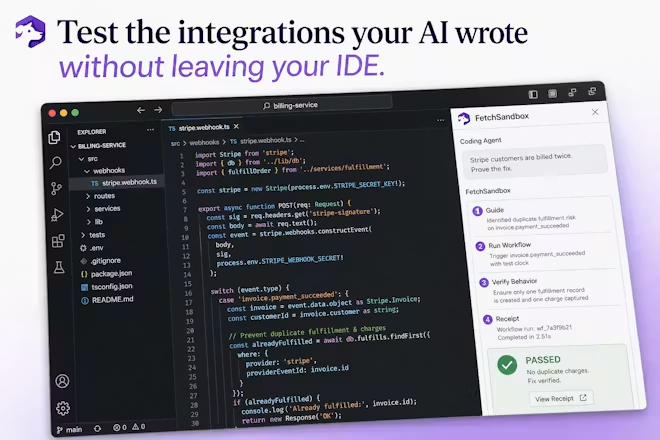
The platform is particularly valuable for modern development teams working with AI-powered coding assistants such as Cursor, Claude Code, Codex CLI, Windsurf, and Visual Studio Code. Rather than switching between multiple tools, developers can integrate FetchSandbox directly into their existing workflow and simulate API behavior without leaving their IDE. This streamlined approach reduces development time while improving testing accuracy.
One of FetchSandbox's biggest strengths is its support for stateful API simulations. Unlike traditional mock servers that simply return predefined responses, FetchSandbox maintains application state across multiple API requests. For example, if a developer creates a customer using a simulated payment API, subsequent requests can retrieve or update that same customer. This makes it possible to test complete user journeys, subscription lifecycles, payment processing, webhook events, retries, and asynchronous workflows in an environment that behaves much closer to production.
The platform also supports many popular APIs out of the box, including Stripe, GitHub, OpenAI, Twilio, Resend, Shopify, Clerk, Paddle, and numerous others. Developers can also upload their own OpenAPI specifications to generate custom sandbox environments automatically. This eliminates the need to manually build mock servers and significantly reduces setup time for new integrations.
Another standout capability is webhook simulation. Many real-world integrations depend on webhooks for notifications and asynchronous events, but testing them with production services is often slow and complicated. FetchSandbox automatically generates webhook events, allowing developers to validate event handling, retry logic, signature verification, and state transitions before releasing software. This helps teams identify integration bugs early and improves application reliability.
FetchSandbox also focuses on developer productivity. Its CLI, MCP server, and browser-based interface allow teams to spin up fully functional testing environments within seconds. Since developers are not consuming real API quotas or modifying production data, they can experiment freely, automate tests, and repeatedly execute integration scenarios without additional costs or risk. This makes the platform especially useful for CI/CD pipelines, automated testing, and collaborative software development.
Pricing is another attractive aspect of the platform. FetchSandbox offers a generous free tier that includes monthly test runs, access to bundled APIs, OpenAPI imports, and developer tools. For growing teams, affordable paid plans unlock higher usage limits, private integrations, webhook replay history, team collaboration features, and enterprise-grade security options such as SSO, audit logs, and private storage.
Overall, FetchSandbox is an excellent solution for developers building API-driven applications. Its realistic sandbox environments, stateful testing capabilities, webhook simulation, AI-assisted workflow support, and broad API compatibility make it far more powerful than traditional mock servers for integration testing. Whether you're an independent developer, startup, or enterprise engineering team, FetchSandbox helps reduce debugging time, improve software quality, and deploy API integrations with greater confidence.
Key features
- Simulates real API behavior with persistent data across multiple requests instead of static responses.
- Automatically generates webhook events, retries, and asynchronous workflows for realistic integration testing.
- Upload OpenAPI specifications to automatically create fully functional sandbox environments.
- Works with Cursor, Claude Code, Codex CLI, VS Code, Windsurf, and other AI-assisted development tools.
- Includes ready-to-use sandboxes for popular APIs like Stripe, GitHub, OpenAI, Twilio, Shopify, Clerk, Paddle, and more.
Pros
- Realistic stateful API testing
- Supports webhook and async workflow validation
- Easy integration with AI coding assistants
- Fast setup with minimal configuration
- OpenAPI-based sandbox generation
- Multiple popular APIs available out of the box
- Free tier available for developers
- Saves API costs by avoiding production requests
- Helpful for CI/CD automation
- Suitable for individuals, startups, and enterprise teams
Cons
- Primarily designed for developers; beginners may face a learning curve.
- Advanced collaboration and enterprise features require a paid subscription.
- Best suited for API integration testing rather than general software testing.
- Some highly customized API behaviors may still require manual configuration.
- Teams unfamiliar with OpenAPI specifications may need additional onboarding.
Reviews
Reviews are moderated before appearing publicly.
No reviews yet — be the first to share your experience.
Disclaimer: Product information is submitted by makers and reviewed by ProductReveal before publishing. We try to keep details accurate, but pricing, features, and availability may change. Please verify details on the official product website.