 ProductReveal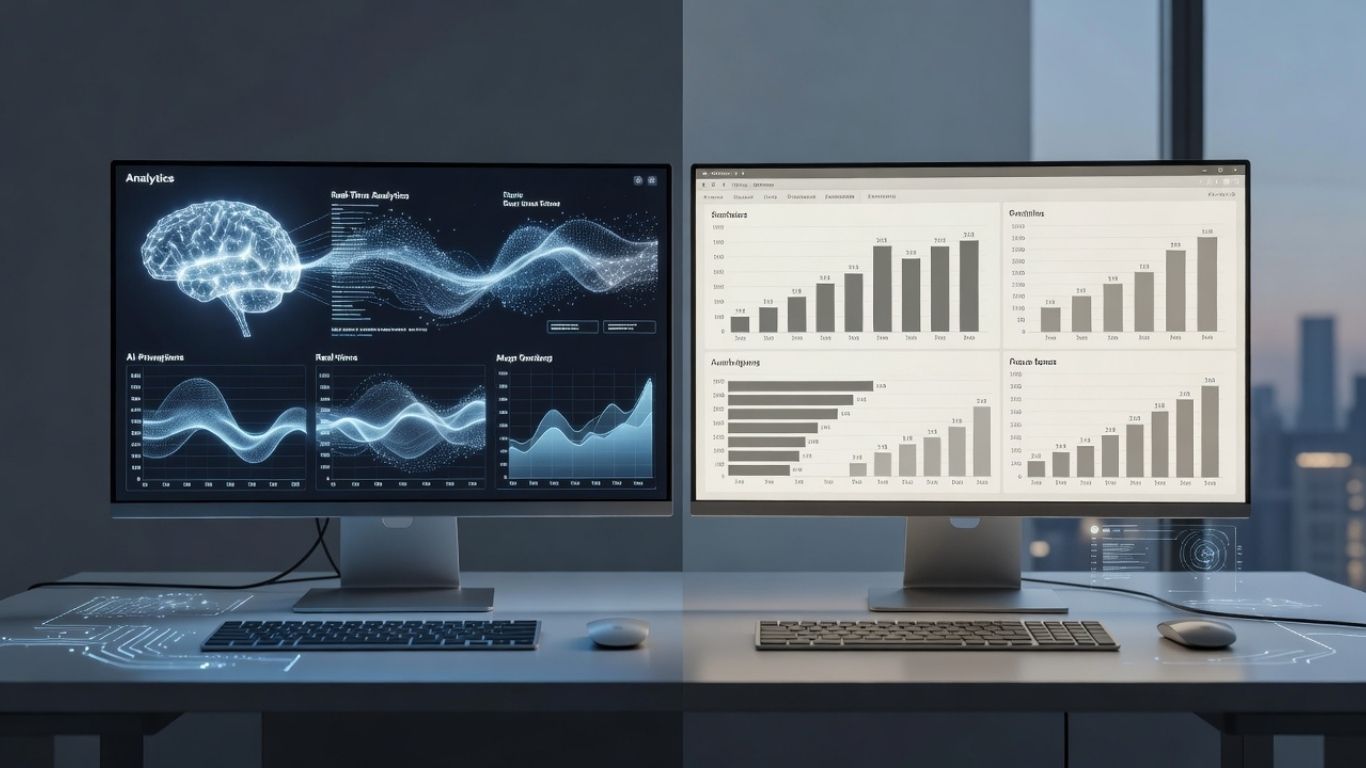
Introduction
Software runs almost everything around us. From the app you use to order coffee to the system that manages a hospital's patient records — software is everywhere. But not all software works the same way.
Over the last decade, a major shift has happened in the tech world. Artificial intelligence software has moved from science fiction to everyday reality. And now, many businesses and individuals are asking the same question: Should I stick with traditional software, or is it time to embrace AI?
It's a fair question. Both types of software serve real purposes. Both have genuine strengths. And both come with limitations that people often overlook.
I've spent years evaluating software systems across industries. What I've noticed is that most people don't fail because they chose the "wrong" type of software. They fail because they didn't understand the difference between the two — and made a decision without enough information.
This article fixes that. Whether you're a business owner exploring automation, a developer weighing your tech stack, or simply a curious reader who wants to understand how this all works — you'll walk away with a clear, practical understanding of AI vs traditional software.
Let's get into it.
What Is Traditional Software?
Traditional software is what most people think of when they hear the word "software." It follows a fixed set of rules written by developers. Every output is determined by a specific input, and the logic doesn't change unless a human programmer updates it.
Think of it like a recipe. If you follow every step correctly, you always get the same dish. Change nothing, get the same result. That's exactly how traditional software systems work.
Examples you've probably used:
Microsoft Excel
Basic inventory management systems
A simple contact form on a website
Payroll processing software
Traditional software is deterministic. That means: same input, same output, every time. It's predictable, which is actually one of its biggest advantages — especially in environments where consistency and reliability matter above everything else.
What Is AI Software?
Artificial intelligence software is different in a fundamental way. Instead of following rigid, pre-written rules, AI software learns from data. It identifies patterns, makes predictions, and improves its performance over time based on experience.
You don't program AI software to do every specific thing. Instead, you train it — by feeding it large amounts of data and letting it figure out patterns on its own.
Here are some familiar examples of AI applications:
Netflix recommendations
Spam filters in Gmail
ChatGPT and other large language models
Face recognition on your smartphone
Fraud detection in banking
AI software is probabilistic. That means it doesn't always give you the exact same result for the same input. It makes its best prediction based on what it has learned. This makes it powerful in complex, dynamic situations — but it also introduces uncertainty.

Key Differences Between AI and Traditional Software
The differences go deeper than just "one is smarter than the other." Here's what really sets them apart:
1. Decision-Making Approach
Traditional software makes decisions based on explicit if-then logic. AI software makes decisions based on learned patterns from training data.
2. Adaptability
Traditional software stays the same until a developer manually updates the code. AI software can adapt and improve as it processes more data, without requiring code changes.
3. Handling Uncertainty
Traditional software struggles when it encounters situations outside its programmed rules. AI software is built to handle ambiguity and incomplete information.
4. Development Process
Building traditional software means writing detailed, specific instructions for every possible scenario. Building AI software means curating training data, choosing the right model architecture, and iterating through training cycles.
5. Transparency
Traditional software is highly transparent — you can trace exactly why it produced a specific output. AI software, especially deep learning models, often works as a "black box," making it harder to explain its decisions.
How Traditional Software Works
Traditional software operates on a straightforward flow:
Input → Processing (fixed rules) → Output
A developer writes every rule in advance. The software reads an input, checks it against those rules, and returns a result. There's no learning, no guessing, no surprise.
Take a payroll system as an example. You enter the number of hours an employee worked, their hourly rate, and the software calculates their pay. The formula never changes unless someone edits the code. It doesn't "get better" at calculating pay over time — it just executes the same instructions, accurately, every single time.
This approach works beautifully for tasks that are:
Well-defined and repetitive
Require precise, consistent results
Don't change frequently
Need full auditability and traceability
How AI Software Learns and Adapts
AI software learns through a process called machine learning. Here's the simplified version of how it works:
Data Collection — Large amounts of relevant data are gathered.
Training — The AI model processes this data and identifies patterns.
Testing — The model is evaluated on new data it hasn't seen before.
Deployment — The model is released into the real world.
Continuous Learning — Some AI systems continue learning from new data after deployment.
This is why your Gmail spam filter keeps getting better. Every time you mark an email as spam, the system learns from your behavior and adjusts its future predictions.
AI models use techniques like neural networks, decision trees, natural language processing (NLP), and reinforcement learning depending on the task. These aren't magic — they're sophisticated mathematical models that find patterns in numbers.
Benefits of AI Software
1. Handles Complexity Effortlessly
AI excels at tasks that would take humans enormous time and effort. Analyzing thousands of medical images, processing millions of transactions for fraud, translating languages in real time — these are things traditional software simply cannot do effectively.
2. Improves Over Time
One of AI's biggest advantages is its ability to get better with more data. Unlike traditional software, which stays static, AI software can become more accurate and capable as it processes new information.
3. Personalizes Experiences
AI powers the personalization you see on every major digital platform. Spotify suggests songs based on your listening history. Amazon recommends products based on your shopping behavior. This level of dynamic personalization is impossible with rule-based systems.
4. Automates Complex Decision-Making
AI can automate decisions that used to require human judgment — like approving a loan application or flagging a suspicious transaction — dramatically increasing speed and operational efficiency.
5. Scales Intelligently
AI systems can handle exponentially more data without a proportional increase in development effort. Once a model is trained, it can process millions of requests with the same quality.

Benefits of Traditional Software
1. Reliability and Consistency
When you need the same result every time, traditional software is unmatched. Payroll calculations, tax processing, database management — these demand exact, repeatable results.
2. Full Transparency
You can audit every decision a traditional system makes. In industries like finance, healthcare, and law, this traceability is not optional — it's legally required.
3. Lower Development Cost (For Defined Tasks)
For well-defined problems with clear rules, traditional software is typically faster and cheaper to build. You don't need massive datasets or complex model training.
4. Easier Debugging
When something goes wrong in traditional software, finding the bug is straightforward. In AI systems, diagnosing unexpected behavior can be genuinely difficult.
5. Works Without Large Data Sets
Traditional software doesn't need historical data to function. You can deploy it immediately after development without a training phase.
Limitations of AI Software
Requires massive amounts of quality data — Without good data, AI performs poorly.
Difficult to explain decisions — This is a serious problem in regulated industries.
Can inherit biases — If training data contains biases, the AI will too.
Expensive to build and train — Large AI models require significant computational resources.
Can fail unpredictably — AI doesn't always fail in obvious, traceable ways.
Security vulnerabilities — AI systems can be manipulated through adversarial attacks.
Limitations of Traditional Software
Cannot handle ambiguity — If a situation isn't pre-programmed, it breaks.
Doesn't improve automatically — Every improvement requires manual developer effort.
Limited personalization — It treats every user the same way.
Becomes outdated quickly — Rapidly changing environments require constant code updates.
Struggles at scale — Complex, large-scale dynamic problems quickly become unmanageable with rule-based logic.
Real-World Examples of Each
Traditional Software in Action:
QuickBooks — Accounting software that follows fixed tax and financial rules.
Microsoft Word — A word processor that executes the exact functions you tell it to.
Traffic light control systems — Follow fixed timing rules set by engineers.
AI Software in Action:
Google Search — Understands the intent behind your query, not just keywords.
Tesla Autopilot — Processes real-time visual data to make driving decisions.
Grammarly — Understands context to suggest grammatically and stylistically appropriate changes.
IBM Watson — Analyzes medical data to help doctors with diagnoses.
AI Software in Business Applications
Businesses are increasingly turning to intelligent software to solve problems that rule-based systems can't touch:
Customer service — AI chatbots handle thousands of inquiries simultaneously.
Marketing — AI tools analyze customer behavior and optimize ad targeting in real time.
Supply chain — Predictive AI forecasts demand and prevents shortages.
HR and recruiting — AI screens resumes and predicts candidate success rates.
Healthcare — AI assists radiologists by flagging anomalies in scans.
Cybersecurity — AI detects unusual network behavior that might indicate a breach.
Traditional Software in Business Applications
Traditional software still dominates in many critical business functions:
Accounting and payroll — Requires exact, auditable calculations every time.
Enterprise Resource Planning (ERP) — Systems like SAP manage structured business processes.
Database management — SQL-based systems store and retrieve structured data reliably.
Point of sale (POS) systems — Process transactions with consistent, predictable logic.
Manufacturing control systems — Follow precise operational instructions to run machinery.
Cost Comparison
This is where many businesses make uninformed decisions.
Traditional Software:
Lower initial development cost for defined tasks
Maintenance costs are predictable
Scaling can become expensive as rule complexity grows
AI Software:
Higher upfront cost for data collection, labeling, and model training
Infrastructure (cloud computing, GPUs) adds significant expense
Long-term cost can decrease as the model improves and requires fewer human interventions
Open-source AI models (like those from Hugging Face or Meta) are reducing entry costs significantly
The honest take: For small, well-defined problems — traditional software is almost always cheaper. For complex, large-scale, dynamic problems — AI often becomes more cost-effective over time, despite higher upfront investment.

Security and Privacy Considerations
Traditional Software Risks:
Vulnerable to known exploits if not regularly patched
Data breaches through SQL injection and other classic attack vectors
Security is generally well-understood and manageable
AI Software Risks:
Adversarial attacks — Hackers can subtly manipulate inputs to fool AI models.
Training data poisoning — Feeding corrupted data into an AI system can compromise its behavior.
Privacy concerns — AI often requires access to large personal datasets, raising GDPR and data privacy issues.
Model theft — Competitors can sometimes reverse-engineer AI models through API probing.
Both types carry security risks. AI introduces some unique attack surfaces that cybersecurity teams need to specifically prepare for.
Future of AI and Traditional Software
Here's what I believe, based on observing this industry closely: these two approaches are not heading toward a winner-takes-all scenario. They're converging.
Modern software is increasingly hybrid. Microsoft Excel now has AI features built in. Traditional ERP systems like SAP are integrating machine learning modules. CRMs like Salesforce now include AI-powered sales predictions alongside their traditional database features.
The future of software will likely look like this: a structured, rule-based backbone (for reliability and compliance) with AI layers on top (for intelligence and personalization).
What's clear is that AI won't replace traditional software anytime soon — especially in regulated industries where auditability is non-negotiable. But AI will fundamentally change how we interact with and enhance traditional systems.
Developers who understand both paradigms will be the most valuable professionals in the next decade.
Common Misconceptions
"AI is always smarter than traditional software."
Not true. An AI system given poor data will outperform neither. Traditional software does its job perfectly within its defined scope.
"Traditional software is outdated."
Absolutely not. Banks, hospitals, and governments run on traditional software systems that are highly effective, reliable, and trusted.
"AI can replace all manual coding."
Not yet, and probably not for critical systems anytime soon. AI-generated code still requires human review and testing.
"AI software is always more expensive."
For large, dynamic problems — it often becomes more cost-effective over time. But for small, defined tasks, traditional software is clearly cheaper.
"AI always makes better decisions than humans."
AI performs well within its training distribution. Outside of it, AI can fail in unexpected and hard-to-detect ways.
Frequently Asked Questions
1. Can AI software completely replace traditional software?
No. Traditional software remains superior for tasks requiring exact, consistent, auditable results. AI supplements rather than replaces it. Most modern systems combine both approaches for best results.
2. Is AI software harder to develop than traditional software?
Generally, yes. AI software requires data collection, model selection, training, and evaluation — which adds significant complexity. Traditional software requires only coding logic, which is more straightforward for defined problems.
3. Which type of software is more secure?
Both have security vulnerabilities, but AI introduces unique risks like adversarial attacks and training data poisoning. Traditional software's security risks are better understood and have established mitigation strategies.
4. Do I need a lot of data to use AI software?
Most AI systems do require substantial quality data to perform well. Limited or poor-quality data leads to poor AI performance. Some pre-trained models reduce this requirement by allowing fine-tuning on smaller datasets.
5. What are the best examples of hybrid software?
Modern examples include Google Docs (traditional text editing + AI grammar suggestions), Salesforce (CRM + AI sales forecasting), and Microsoft Azure (cloud infrastructure + AI services).
6. Is AI software suitable for small businesses?
It depends on the use case. AI-powered tools like chatbots, email marketing platforms, and analytics tools are accessible to small businesses. Custom AI development, however, typically requires larger budgets.
7. How do I decide which type of software is right for my business?
Start by defining your problem. If it's structured and repetitive — traditional software likely serves you better. If it involves large, complex, dynamic data and requires prediction or personalization — AI software is worth exploring.
8. Will traditional software become obsolete?
Not anytime soon. Traditional software will continue to be the foundation of critical systems in finance, government, healthcare, and manufacturing where reliability, compliance, and full traceability are mandatory.
Key Takeaways
Traditional software follows fixed, pre-written rules. It's reliable, transparent, and ideal for structured, repetitive tasks.
AI software learns from data, adapts over time, and handles complex, dynamic problems that rule-based systems can't.
Neither is universally superior. The right choice depends entirely on your specific problem, available data, budget, and compliance requirements.
Most modern enterprise software is becoming hybrid — combining the reliability of traditional logic with the intelligence of AI layers.
AI requires good data to work well. Without quality data, AI underperforms and can even cause harm through biased outputs.
Cost isn't straightforward. Traditional software is cheaper upfront for defined tasks. AI can be more cost-effective long-term for complex, large-scale problems.
Security considerations differ. AI introduces unique attack surfaces that require specific cybersecurity preparation.
The future belongs to professionals and businesses who understand both — and know when to apply each.
Conclusion
The debate around AI vs traditional software isn't really about which one is better. It's about which one is better for a specific job.
Traditional software is like a master craftsman who follows a proven process with perfect precision every time. AI software is like an experienced analyst who reads patterns, adapts to new information, and makes increasingly better predictions over time. You need both, depending on what you're building or solving.
As automation software becomes more embedded in everyday tools, the line between these two categories will continue to blur. But the underlying principles — deterministic rule-following versus probabilistic learning — will remain distinct, and understanding that distinction will always matter.
Whether you're evaluating software for your business, learning about the technology industry, or making a career decision in tech — knowing the difference between AI and traditional software gives you a genuine edge.
Use this knowledge to ask better questions, make smarter decisions, and choose the right tool for the right job. That's what separates informed technology decisions from expensive mistakes.
About the author
The ProductReveal editorial team writes original guides and reviews for makers.